
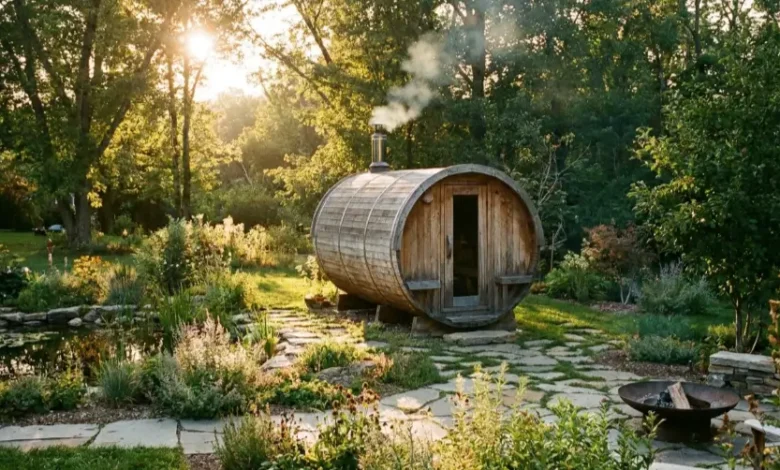
A barrel sauna needs a flat, well-drained, stable surface under its cradle stand, and the five common choices are a compacted gravel pad, interlocking pavers, a poured concrete slab, an existing or new wood deck, and a composite or rubber base pad. Gravel is the cheapest and most common for a first-time installation; a poured slab is the most permanent and most expensive. None of the five is wrong, but each fits a different budget and site.
Option One: Compacted Gravel Pad
A gravel pad is the default choice for a reason: it drains well, it’s forgiving of an imperfectly level yard, and it’s the cheapest option most first-time owners will find, typically $150 to $500 in materials for a DIY build. The standard build is four to six inches of crushed gravel over a compacted base, sometimes with a layer of landscape fabric underneath to slow weed growth. The tradeoff is that gravel needs occasional raking and top-up over the years as it settles, and it’s not a great surface for bare feet, so a small mat or step near the door is worth adding.
Option Two: Interlocking Pavers
Pavers cost more than loose gravel, usually $500 to $1,200 for a barrel-sized pad depending on the paver style and whether it’s installed by a landscaper or DIY, but they give a flatter, more finished surface that’s more comfortable to walk on barefoot. They still need a properly compacted base underneath to prevent shifting, so skipping that prep step to save time is the most common paver mistake. Once set correctly, a paver pad needs very little maintenance beyond occasional re-leveling if a section settles unevenly.
Option Three: Poured Concrete Slab
A concrete slab is the most permanent and typically the most expensive option, often $800 to $2,500 depending on size and region, and it’s the surface least likely to shift or settle over time. It’s also the option most likely to require a permit, since a poured slab counts as a permanent structure in many municipalities where gravel or pavers do not. A slab makes sense for owners who know the barrel’s location is fixed for good and want zero maintenance on the base itself for years.
Option Four: An Existing or New Wood Deck
Placing a barrel sauna on a wood deck works well if the deck’s joists and footings are rated to handle the load, which is concentrated at the cradle stand’s contact points rather than spread evenly across the deck boards, unlike a person simply standing on the surface. A finished barrel weighs 800 to 1,500 pounds depending on diameter, so an older deck built for light patio furniture may need reinforcement before a barrel goes on it. A contractor or structural inspection is worth the cost here, since the failure mode of an under-built deck is not obvious until it’s already loaded.
Option Five: A Composite or Rubber Base Pad
Pre-made composite or rubber base pads, sold specifically for outdoor equipment like sheds and hot tubs, are a middle option: faster to install than gravel or pavers since there’s no digging or compacting required, and typically $300 to $800 for a barrel-sized footprint. They sit directly on graded, level ground and interlock like large tiles. They’re a reasonable choice for renters or anyone who might need to relocate the barrel later, since the pad can be picked up and moved, unlike gravel, pavers, or concrete.
How to Choose Between These Five
Budget and permanence are the two questions that actually decide this. A gravel pad or composite base pad suits a first barrel sauna or a site that might change in a few years. Pavers split the difference: more finished than gravel, less permanent and less costly than a slab. A poured slab or a load-checked existing deck makes sense once you’re confident the barrel’s spot is fixed for the long term. Whichever base you choose, extend it at least 12 to 18 inches beyond the barrel’s footprint on all sides, since rain running off the curved roof lands closer to the walls than people expect, and a base that stops right at the barrel’s edge stays wet longer than one with a small margin. Several base-ready barrel models from SweatDecks list recommended pad dimensions directly on the product page, which is worth checking before buying materials.
What About Freeze-Thaw Climates?
In regions with hard winters, ground movement from freezing and thawing is the main reason a base that looked level in October is noticeably off by March. Gravel and paver pads handle this better than a rigid concrete slab in most cases, since the loose material can shift slightly with frost heave without cracking, while a slab poured on ground that wasn’t excavated below the frost line can crack or tilt over a few winters. A local contractor familiar with frost depth in your area is worth consulting before pouring concrete specifically, even though gravel and pavers rarely need that level of planning.
Getting the Ground Prep Right the First Time
Whatever surface you choose, grade the site so water runs away from the barrel rather than pooling under it, and confirm the surface is level before the barrel arrives rather than after, since shimming a fully assembled barrel is a much harder fix than correcting an unlevel pad ahead of time. A few hours of prep work before delivery day saves a redo later, and it’s the single detail that most affects how the door, hoops, and staves hold up over the barrel’s first few years.
Frequently Asked Questions
Can you put a barrel sauna directly on grass or dirt?
It’s not recommended. Bare ground shifts with rain and frost, which can throw the cradle stand out of level and eventually put the door frame out of square.
What is the cheapest base for a barrel sauna?
A compacted gravel pad, typically $150 to $500 in materials for a DIY installation, is usually the least expensive option that still meets the needed drainage and stability.
Do you need a permit for a concrete slab under a barrel sauna?
Often yes, since a poured slab counts as a permanent structure in many municipalities, while a gravel or paver pad frequently does not require one.
Can a barrel sauna sit on an existing wood deck?
Yes, if the deck’s joists and footings are rated for the barrel’s weight, typically 800 to 1,500 pounds concentrated on the cradle stand’s contact points.
How much bigger should the base be than the barrel itself?
Most installers recommend extending the pad at least 12 to 18 inches beyond the barrel’s footprint on all sides to catch runoff and give the door a dry step.
References
- Cardiovascular and Other Health Benefits of Sauna Bathing: A Review of the Evidence (Mayo Clinic Proceedings, 2018)
- Clinical Effects of Regular Dry Sauna Bathing: A Systematic Review (Evidence-Based Complementary and Alternative Medicine, 2018)
- Benefits and risks of sauna bathing (The American Journal of Medicine, 2001)
- National Fire Protection Association
By Colleen Marsh

